
You’ve tried the drops. They work for an hour, then it’s back. Here’s the reason most chronic dry eye never fully resolves — and what actually changes it.
You buy the drops. They help for an hour, maybe two. Then the burning comes back, your vision goes soft at the end of the day, and you are reaching for the bottle again. If that is your routine, you are not doing anything wrong — you are treating the wrong problem.
Dry eye usually isn’t a tear shortage
Most people assume dry eye means their eyes do not make enough tears. For the majority of chronic cases, that is not it at all. The tears are there. They are just evaporating too fast.
A healthy tear film has three layers working together:
- An oily outer layer that seals the surface and slows evaporation
- A watery middle layer that hydrates the eye
- A mucin base layer that anchors everything and spreads it evenly
That oil comes from the meibomian glands — roughly 25 to 30 tiny glands along each eyelid margin, right behind your lashes. Every time you blink, they release a thin film of oil across the surface of your eye.
When those glands become blocked or inflamed, the oil stops flowing. Your tears are still being produced, but with nothing sealing them in, they evaporate within seconds. That is called evaporative dry eye, and it accounts for the large majority of chronic dry eye cases we see.
Which is exactly why drops stop working
Artificial tears add water to the surface of your eye. If the problem is that water evaporates too quickly, adding more water gives you relief for as long as it takes to evaporate — and then you are back where you started.
It is the reason people end up using drops four, six, eight times a day and still feel like nothing has actually improved. The drops are not failing. They are just not aimed at the cause.
Signs your dry eye is the evaporative kind
- Burning or stinging that gets worse through the day
- Vision that blurs, then clears when you blink
- Eyes that water constantly — reflex tearing is a dry eye symptom
- A gritty, sandy feeling, especially late in the day
- Red or crusty eyelid margins
- Contact lenses that used to be comfortable and no longer are
- Symptoms that flare in wind, air conditioning, or in front of a screen
What actually treats the cause
If the glands are the problem, treatment has to reach the glands. That is a different category of care than anything in a bottle.
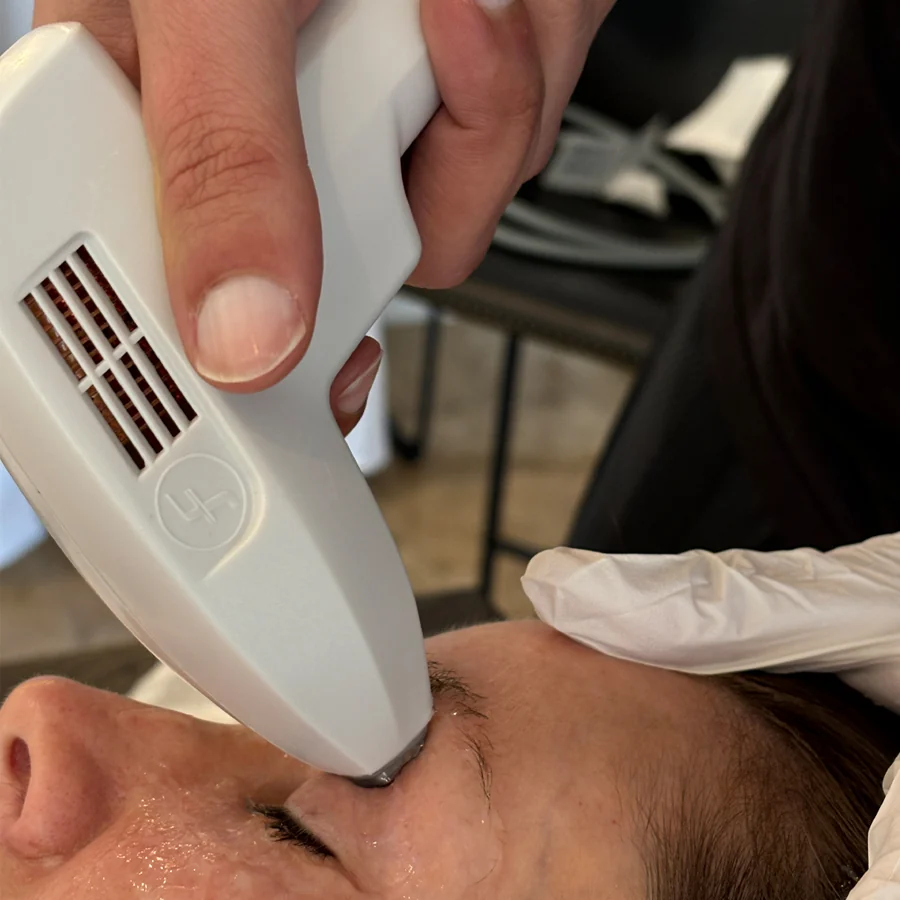
Intense Pulsed Light (IPL) delivers controlled pulses of light to the skin around the eyes. It closes off the abnormal blood vessels that drive inflammation, reduces bacteria and Demodex mites along the lash line, and warms the glands so hardened oil can move again.
Radiofrequency (RF) uses gentle, controlled heat that reaches deeper tissue, liquefying the thickened oil inside the glands so it can finally be expressed and flow normally.
Low-Level Light Therapy calms inflammation at the cellular level and supports the glands’ own recovery. It is often combined with the other two.
Used together, these address the inflammation and the blockage at the same time — which is why the results tend to hold rather than fade by lunchtime.
Where to start
Before any treatment, the glands need to actually be looked at. A dry eye evaluation images the meibomian glands, measures your tear film, and examines the lid margin so we know what is driving your symptoms — because occasionally it genuinely is a tear production issue, or an allergy issue, and the plan should follow the findings rather than a guess.
Dr. Carrie Roitstein has spent three decades on this, with a particular focus on non-toxic, drug-free approaches to ocular surface disease. If you have been managing dry eye for years and quietly accepted it as normal, it is worth one conversation to find out what is actually going on.
Stop managing it. Start treating it.
Book a dry eye evaluation at our Gold Coast or Hinsdale location.
Dry eye treatment at both locations — Gold Coast and Hinsdale. Also read: what IPL actually costs.